
The Carpenter and the Rat Pit
The Painted BirdThis thread traces how the carpenter’s fear of lightning leads to The boy’s flight, a desperate bargain over a bunker, and a reversal in which the carpenter falls into the rats he meant to exploit.
increasing Bearing strength in each event
 decreasing
Bearing strength in each eventdecreasingA Child Blamed for Lightning
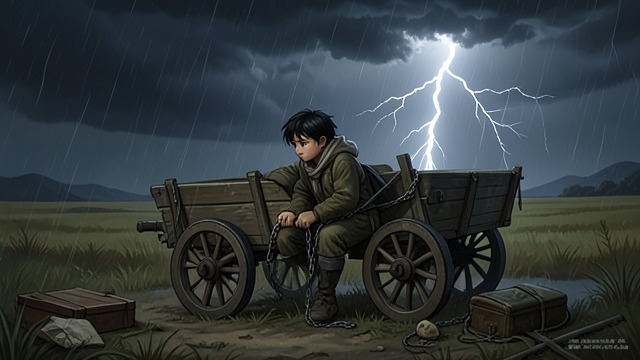
A Child Blamed for Lightning
Superstition as a sentence
The carpenter and his wife believe The boy’s black hair attracts lightning. When storms approach, the carpenter chains him to a harness, puts him in a cart, and leaves him alone in a distant field. A belief about danger becomes a repeated punishment imposed on the child.
The boy endures storms in terror, imagining demons and other beings moving through the dark. The carpenter’s precautions isolate him from shelter precisely when he most needs it, turning superstition into a physical threat.
The storm takes hold
One afternoon the carpenter is ill and does not drive The boy away before a storm. The child hides in the barn, but lightning strikes and the building catches fire. Amid the village’s confusion, The boy believes his hair may have brought about the blaze and fears that the crowd will kill him.
He flees into the forest as villagers rush toward the fire. The escape is prompted by both immediate danger and the old accusation that he himself is a source of disaster.
A Bunker of Rats
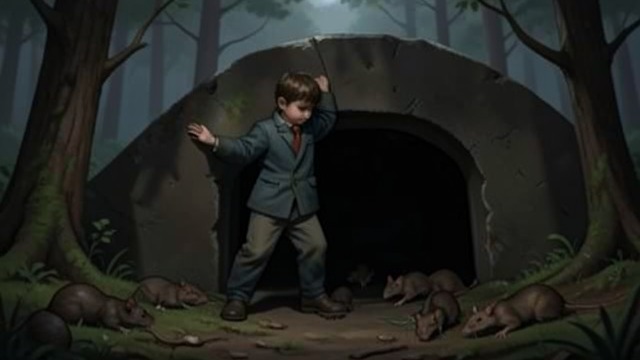
A Bunker of Rats
A discovery in the forest
After leaving the village, The boy finds an abandoned military bunker. Hearing squeaking within, he reflects sunlight into its opening and sees a churning mass of rats fighting and eating one another in the enclosed pit.
The sight shows him a world of competition without refuge, where each animal struggles upward at the expense of the others. He covers the opening and continues through the forest, carrying the discovery as both a danger and a possible means of escape.
Return to the same village
At dusk, The boy reaches a farm and discovers that it belongs to the same village from which he fled. The carpenter recognizes him and has him beaten, then prepares a sack as though he intends to drown him like a sick cat.
To avoid that fate, the boy claims he can show the carpenter a bunker containing valuable military belongings. He has no guarantee that the lie will save him, but it gives him a reason to get the carpenter away from the village and back to the rats’ pit.
A Bargain for Life
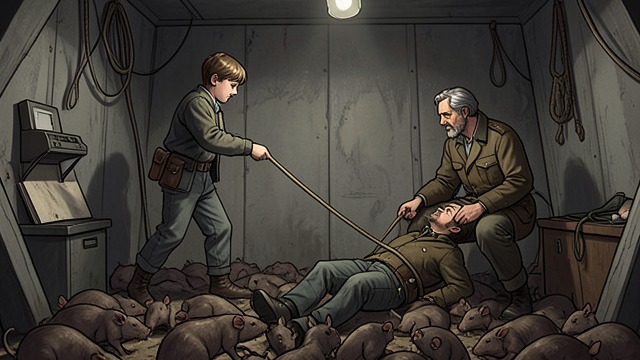
A Bargain for Life
The carpenter follows the lead
The carpenter ties The boy to himself, takes an ax, and drives a cart to the bunker. The boy watches for a chance to break free, knowing that if the carpenter sees through the story he may kill him and leave his body in the pit.
At the opening, the carpenter pushes aside the cover and leans toward the darkness to inspect what is inside. The boy carefully moves to the opposite side, placing the hole between them and pulling the tether taut.
The reversal
The boy yanks suddenly, cutting his wrist as the string draws the carpenter forward. The carpenter falls into the bunker and disappears beneath the mass of rats. The boy’s escape depends on the same pit he had first found while fleeing the fire, and on a deliberate action taken at the instant the carpenter is most vulnerable.
From the opening, The boy watches the rats consume the fallen man. The former captor becomes helpless inside the world he had been persuaded to inspect, reversing the relation of power between them without making the boy’s escape emotionally simple.
Flight with the Ox Cart
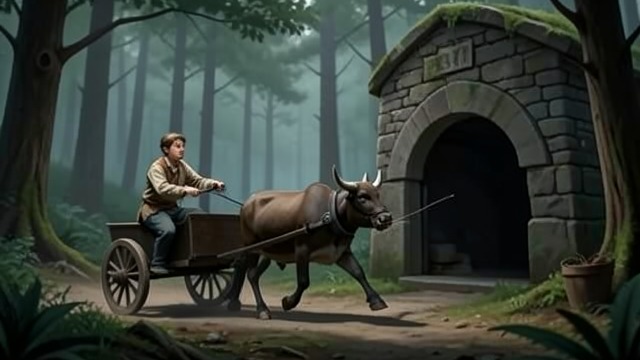
Flight with the Ox Cart
Taking the means of escape
The boy seizes the carpenter’s ax and reaches the cart, where the ox is still grazing. The animal does not move at first without its master, so The boy strikes it with the whip until it pulls the cart away from the bunker.
He drives through forests and clearings without knowing the road, concentrating on getting as far as possible from the carpenter’s village. The escape involves a stolen vehicle and animal, but it also leaves him responsible for keeping both alive while remaining hidden.
Distance and uncertainty
The boy travels for two days, once narrowly avoiding a military outpost at a sawmill. The ox grows lean as they continue, and the boy avoids roads bearing fresh traces of peasant traffic.
When they reach another village, he offers the cart and ox in exchange for shelter and food. The bargain ends the flight from the carpenter’s immediate reach, but his acceptance into a new household still depends on another stranger deciding that he is worth keeping.
An Escape Bought with Fear
An Escape Bought with Fear
A new transaction
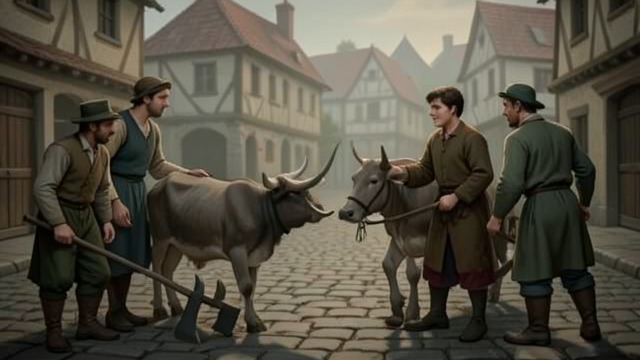
The boy reaches a village and offers his cart and ox to a peasant in return for food and shelter. The peasant consults his wife and neighbors before agreeing, inspecting the animal’s teeth and then The boy’s. Even after the escape, the child’s security is subject to evaluation by adults who control access to a home.
The carpenter’s death has freed The boy from one immediate captor, but it has not ended the recurring pattern in which survival requires negotiation. He cannot rely on a lasting right to stay; he must present himself as useful and avoid raising suspicion.
The danger remains behind him
The boy leaves the bunker with the carpenter’s ax and the ox cart, while the carpenter remains among the rats. His escape is decisive in action but does not deliver him from the wider dangers of war, poverty, or village hostility.
The episode’s reversal is therefore temporary rather than triumphant. The boy has survived by reading an adult’s greed and exploiting a place of danger, but his next shelter is another precarious arrangement made under pressure.
During The boy’s stay with the carpenter
After escaping the burning barn
At dawn on the day after The boy is recaptured
Immediately after the carpenter falls into the bunker
After two days of flight from the bunker
